A Teacher’s Legacy

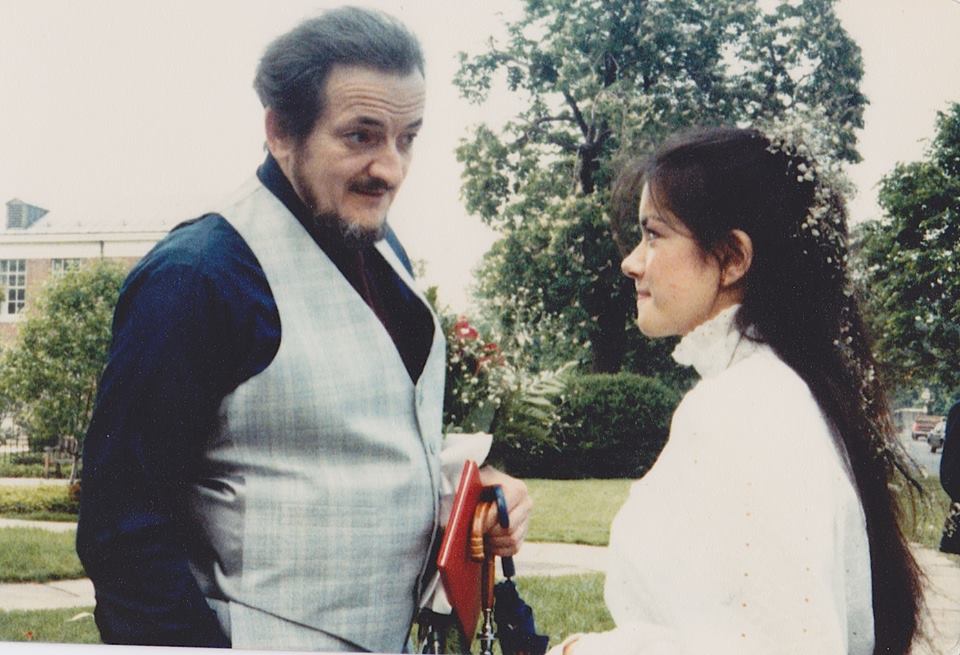
I was about seven the first time I saw my father teach. I sat in the back of the lecture room, scribbling in an examination “blue book.” Every once in a while, I looked up at the people seated near me, unwitting inspiration for my imaginative stories. Next to the blackboard was a tall man, gesturing wildly with chalk in hand, his usually soft voice at full volume as he punctuated his lecture with anecdotes from history. Like a born-again preacher wooing his congregation, my father spoke zealously. His gospel for students? Learn about history in order to understand your grandparents, your parents — and yourselves.

I remember asking him many years ago if he liked his job. He smiled broadly. “What other job would pay me to read books?” But even then, I knew teaching for him was about more than devouring the latest hardcover analysis of political upheaval. It was about translating scholarly ideas into language that could engage the minds of history majors, business majors and college jocks alike. It was about nurturing the worldview of even the most provincial undergraduate student.

Being the child of an academic had unique perks. Like the dinnertime conversations that enlightened my brother, sister and me about American diplomacy after the Second World War. Or the help I got with a high-school research assignment on the Middle East. Of course, there were also drawbacks to growing up in a family headed by a professor. One Christmas, for example, while most families huddled together in front of the TV to watch “It’s a Wonderful Life,” my father summoned all of us for a video double feature: Leni Riefenstahl’s “Triumph of the Will” followed by Charlie Chaplin’s “The Great Dictator.” Somehow, even family gatherings could turn into history lessons.

A lot has happened since Dad picked up his first piece of chalk. Back in 1963, there were no PowerPoint projectors or VCRs in university lecture halls — nor did any PCs grace the desktops in offices. Yet even after these technological advances made their way onto campus, my father eschewed the wizardry of modern academia. He winced at words like “multimedia,” took his sweet time warming up to chalk replacements like dry-erase markers, and staunchly refused to learn how to use a laptop. Having never learned to type, the eccentric professor relied instead on his distinctive longhand to create syllabi and exams, painstakingly writing out words as well as drawing his own maps.

At times an intellectual curmudgeon, he confronted each student essay with a critical eye. But I can think of no better gift for a student than a set of firm expectations based on high standards. Especially when the teacher holds himself equally accountable. Even for courses he taught repeatedly, my father liked assigning new books so that he, too, could be reading and learning alongside his students. By becoming the wise mentor, he kept himself young at heart.

In a few months, the man who fell in love with teaching some forty years ago will retire from the classroom. While the septuagenarian’s body is more than ready to slow down, his mind for recalling dates and events remains razor-sharp — and his appetite for understanding national identities and global affairs, ravenous. Somehow, I just can’t picture the old man on a golf course.

“Those who can, do. Those who can’t, teach.” Or so the putdown goes. But educators can have a profound influence on the consciousness — and conscience — of each one of us. As Henry Adams said, “A teacher affects eternity; he can never tell where his influence stops.”

Originally titled “Great Professors Exert Profound Influence On Us” and published as a “My View” column in the May 7, 2003 issue of The Buffalo News
Dinosaurs

My five-year-old daughter is in denial. She can’t accept the fact that her current object of affection and admiration, the venerable dinosaur, is extinct. During a recent visit to the science museum, she gives full expression to her indignation. Looking up at the enormous replica of the triceratops, she places her hands squarely on her hips and shouts: “Wake UP!”

But isn’t that the magic of childhood curiosity? Being passionate about something that we adults have long since forgotten, or take for granted?

“No, the Tyrannosaurus Rex is from the Cretaceous period, Mom, not the Jurassic!” My daughter corrects me as I comment on the creature’s distinctive jaw. I am half-thinking about the Spielberg blockbuster from a decade ago. Seeing another parent chuckle from a few feet away, I am humbled not merely by the fact that my precocious child has just set me straight on my science facts, but more importantly, by the realization that with a few spontaneous remarks, she is putting my existence into perspective. Long before all the cars and buildings and cell phones, there were these big amazing animals that walked the earth. Their brains might have been pea-sized in comparison to their mighty bodies, but they managed to survive for quite a while.

Compared to our charges, we adults focus on less sublime matters. I worry about the plummeting stock market and my expanding waistline; meanwhile, energized by her kindergartner’s thirst for knowledge about the world, my child frets over the disappearance of the largest creatures ever to roam our planet. I watch her as she bounces across the room, and then darts from the exhibit about the long neck dinosaur to the museum’s vivid picture of a saber tooth cat, snarling back at her through the glass case.

I see the heartbreak in my daughter’s eyes every time I give her my “I’m the adult” look and remind her that no, the dinosaurs aren’t coming back. “They’ve been dead for a long time, Hanna.” As she crinkles up her nose in irritation, I realize how presumptuous I am. As long as there are eager minds to question and appreciate the grand mysteries of life, nothing about these mysteries will ever truly die.

Children teach us every day to see things for the first time, and to remember them as if they will never disappear, never become extinct. Breathing new life into creatures that have been physically dead for eons, my daughter gives me the gift of spiritual rebirth— and imagination. As we near the end of the exhibit, I look back at the towering models and catch myself smiling. Some day, light years from now, where will the models of the once-great humans be found?

(2001)

Awake

One day when I was young
My father whispered
Did you know
That the safest place
In all the world
Is in your papa’s arms?

I tucked the words inside my head
And went to bed each night
Dreaming.

These are the days
I find myself half-smiling
Remembering those moments
Of happy whispered promises

And those endless childhood nights
When I never once
Dreamed of growing up.

(1983)

Clarity

We talked at the café
looking out into the night
sneaking serious glances
in between
playful smiles

I followed you home
and invited myself to
stay for a bit

(you didn’t seem to mind)

At your house you
finally let me in

(but only for a while)

I spied the bottle of whisky
underneath the desk in your office
way up in that lonely, messy
attic

Your books on literature
were stacked on a shelf in the corner
of your private room

(one, on sonnets, was upside down)

We went downstairs
listened to music
you made me laugh
again and again

Then I saw
your melancholy eyes
and your flushed cheeks
after I knelt down to
kiss you and
feel your warmth
against my face

Time was suspended and I
slipped farther down
into the mystery
of our tangled, temporal
connection

Seems you were
on my mind
that night and
some others

We were
lovers sometimes
enemies too

yet even in friendship
I often ached
to understand

why

Long Ago

I close my eyes and I remember
how we once made each other laugh.
I lived for your smile, which signaled
another moment of our life together, forever,
for a while.

Our youthful dreams intertwined
as we practiced being one.

Then she came.
A bundle of unspeakable pride, utter ecstasy,
and daunting obligation.

Trying to be my mother, I watched as you
learned to become your father.
With a baby to raise
we found ourselves drowning
in images from the past.

Her crying was relentless.
I was weary – you, impatient
the two of us struggling, together
yet growing apart and living each day
in our increasingly
separate worlds.

Alone
I whispered.
Alone, you heard nothing.
We stopped breathing
and instead choked
on unspoken words.

Too many unanswered whispers
and I slowly went mad.

Inside my loneliness I felt teardrops
as thick as the milk
feeding our child.

And I heard the echo of my own voice
calling your name
as she slept in my arms.

Where was I?
I can’t remember.
Where were you?
It doesn’t matter anymore.

A time of unbearable sorrow
has already diminished in intensity
as I realize how much
our baby has grown,
how beautiful and strong
she has become.

I look at her face and
see you, her father,
smiling back at me
just like so many years ago.

(2001)

Outlining: a poem for my mother (and father)

stop growing old
just for a moment
or at least help me understand
my role, my stance
as I find my footing and search for space
between our tentative boundaries.

where do you end and
where do I begin?

I see you: at once an infinitely strong
and courageous woman
who adored her husband and
held our family together
with endless bowls of steaming white rice
and the swirling sounds of music
classical and elegant
sometimes dark and mysterious
this became your gift
enriching our minds, caressing our souls
just like your soft hands and tender kisses
when we were good, or hurt, or eager to sleep.

I look again, and glimpse a face that’s
wrinkled and confused
occasionally distant, yet still familiar
I catch my breath and gaze
the maternal beauty is still there
underneath the weight of time.

now spread across the kitchen table
are letters, bills, and looming decisions
a multitude of worries about how to manage
the gift and burden of
living so long, without him.

where do you end and
how do I begin

even to imagine
a life without you, too.

(2015)

Musings on Fifty

I will wear my wrinkles well
and let the gray come to my hair.
I will resist the temptation to
measure my worth by the lack of soft skin
around my middle.

I will remember my mother and my mother’s mother
and my other grandmother and all the aunts
and I will feel privileged
to join a club of
supremely strong, wise and
beautiful women.

I will not bow down
while looking into the mirror
half-expecting to see a younger image.
I will smile with each memory of youth
that reminds me of how much
I have learned
from so many glorious mistakes.

Yet I will allow myself to pause
just for a moment
as I realize
how our bodies begin to fail us
just as we are beginning
to understand life.

Family ca. 1967

My mother’s worries are fear, love
and anger.

Dad drinks another shot
wiping his brow as he
gently strokes her
soft, dark hair.

He turns for a moment, and she
takes the bottle away.

Another game of hide and seek.

My brother and I
lie still in our beds
awaiting the darkness
and after that

The bright morning sun and
everyone’s
silence.

Family Ties

Papa was tall, silent, and strong
he wept only when he drank
as the liquor flowed, so too the tears.

Pointing to the bottle of scotch,
he’d whisper about love and spirits
and pain.

With his tall body swaying back and forth,
back and forth,
my father was like a tree
being pushed by the wind.

Even as a child, I wanted to catch him
or maybe just

                 run

                                     away.

I grew up and I drank
shouting, weeping
angry at my father
angry at myself
for feeling so alone.

Years have passed and
I am sober.
Yet even today
there are bold and intense
flashes of anger
like a volcano, erupting.

I look and I recognize
the expression of fear
on my daughter’s face

Just like the one I wore
when I was growing up

And so I bend down and
pray.

(2002)